New Owner - Chidliak
De Beers Canada is now the new owner of Chidliak by way of purchasing and is now a 100% owned subsidiary - Peregrine Diamonds.
Here is a link to the official news release -- De Beers 2018 09 13
I have started a new blog to continue my thirst for conquering and sharing diamond knowledge
Here is the new link --> Ekim Diamonds
Note: Several links/images on this blog no longer work as the original peregrine diamonds website is being wound down and this blog will be wound down as well.
If you have any legacy questions on Chidliak, please email direct to stockhouseekim@gmail.com
Thursday, September 13, 2018

Friday, August 31, 2018
Forward Looking
Forward Looking Statements
The vote is in and PGD shareholders have voted overwhelmingly in favor of the 'arrangement'.
Is the deal done? Does De Beers own Peregrine Diamonds and via that, own Chidliak?
Not yet? Maybe? . The courts still need to approve it on Sept 10th and the estimated closing time is Sept 12th.
What about before that? What other outcomes are there?
The answer these questions, one must and should carefully and in fine detail, parse through the forward looking statements that came associated with the August 31st voting news release from Peregrine Diamonds.
Here are the forward looking statements (broken up in pseudo parts):
This news release includes forward-looking statements and information (collectively, the “forward-looking statements”) including, but not limited to:
forward-looking statements pertaining to the purchase by De Beers of all the issued and outstanding common shares of Peregrine;
the anticipated timing for closing of the transaction;
the satisfaction of closing conditions including, without limitation
(i) certain regulatory approvals;
(ii) necessary court approval of the Arrangement,
(iii) certain termination rights available to the parties under the arrangement agreement between them in respect of the Arrangement; and
(iv) other closing conditions, including, without limitation,
the operation and performance of the Peregrine business in the ordinary course until closing of the transaction, and
compliance by Peregrine with various covenants contained in the arrangement agreement, all of which are subject to risks, uncertainties and assumptions.
As a consequence, actual results in the future may differ materially from any expectation, conclusion, forecast or projection in such forward‑looking statements. Therefore, forward‑looking statements should be considered carefully and undue reliance should not be placed on them.
All forward‑looking statements are made pursuant to the safe harbour provisions of applicable Canadian securities legislation.
Forward‑looking statements are subject to risks, uncertainties and assumptions including, but not limited to:
failure to, in a timely manner, or at all, obtain the necessary regulatory and court approvals for the transaction or any transaction ancillary thereto;
failure of the parties to otherwise satisfy the conditions to complete the transaction;
significant transaction costs or unknown liabilities;
the risk of litigation that would prevent or hinder the completion of the transaction;
and other customary risks associated with transactions of this nature.
In addition, if the transaction is not completed, and Peregrine continues as an independent entity, there are risks that the dedication of substantial resources of Peregrine to the completion of the transaction could have an adverse impact on Peregrine’s business and strategic relationships, operating results and business generally. As a consequence, actual results in the future may differ materially from any forward-looking statement, forecast or projection, whether expressed or implied. Therefore, forward‑looking statements should be considered carefully and undue reliance should not be placed on them.
Forward‑looking statements in this news release reflect management’s expectations as of the date hereof and are subject to change thereafter.
The Company disclaims any intention or obligation to update or revise any forward-looking statements, whether as a result of new information, future events or otherwise, except as required by law.
Factors that could cause anticipated opportunities and actual results to differ materially include, but are not limited to, matters referred to above and those matters identified in the “Risks Factors” section and elsewhere in the Company’s most recent annual MD&A and the management proxy circular that were previously filed in respect of this transaction, which are available on the Company’s website at www.pdiam.com and on SEDAR at www.sedar.com.
The vote is in and PGD shareholders have voted overwhelmingly in favor of the 'arrangement'.
Is the deal done? Does De Beers own Peregrine Diamonds and via that, own Chidliak?
Not yet? Maybe? . The courts still need to approve it on Sept 10th and the estimated closing time is Sept 12th.
What about before that? What other outcomes are there?
The answer these questions, one must and should carefully and in fine detail, parse through the forward looking statements that came associated with the August 31st voting news release from Peregrine Diamonds.
Here are the forward looking statements (broken up in pseudo parts):
This news release includes forward-looking statements and information (collectively, the “forward-looking statements”) including, but not limited to:
forward-looking statements pertaining to the purchase by De Beers of all the issued and outstanding common shares of Peregrine;
the anticipated timing for closing of the transaction;
the satisfaction of closing conditions including, without limitation
(i) certain regulatory approvals;
(ii) necessary court approval of the Arrangement,
(iii) certain termination rights available to the parties under the arrangement agreement between them in respect of the Arrangement; and
(iv) other closing conditions, including, without limitation,
the operation and performance of the Peregrine business in the ordinary course until closing of the transaction, and
compliance by Peregrine with various covenants contained in the arrangement agreement, all of which are subject to risks, uncertainties and assumptions.
As a consequence, actual results in the future may differ materially from any expectation, conclusion, forecast or projection in such forward‑looking statements. Therefore, forward‑looking statements should be considered carefully and undue reliance should not be placed on them.
All forward‑looking statements are made pursuant to the safe harbour provisions of applicable Canadian securities legislation.
Forward‑looking statements are subject to risks, uncertainties and assumptions including, but not limited to:
failure to, in a timely manner, or at all, obtain the necessary regulatory and court approvals for the transaction or any transaction ancillary thereto;
failure of the parties to otherwise satisfy the conditions to complete the transaction;
significant transaction costs or unknown liabilities;
the risk of litigation that would prevent or hinder the completion of the transaction;
and other customary risks associated with transactions of this nature.
In addition, if the transaction is not completed, and Peregrine continues as an independent entity, there are risks that the dedication of substantial resources of Peregrine to the completion of the transaction could have an adverse impact on Peregrine’s business and strategic relationships, operating results and business generally. As a consequence, actual results in the future may differ materially from any forward-looking statement, forecast or projection, whether expressed or implied. Therefore, forward‑looking statements should be considered carefully and undue reliance should not be placed on them.
Forward‑looking statements in this news release reflect management’s expectations as of the date hereof and are subject to change thereafter.
The Company disclaims any intention or obligation to update or revise any forward-looking statements, whether as a result of new information, future events or otherwise, except as required by law.
Factors that could cause anticipated opportunities and actual results to differ materially include, but are not limited to, matters referred to above and those matters identified in the “Risks Factors” section and elsewhere in the Company’s most recent annual MD&A and the management proxy circular that were previously filed in respect of this transaction, which are available on the Company’s website at www.pdiam.com and on SEDAR at www.sedar.com.
Thursday, July 19, 2018
Bid for Peregrine Diamonds
De Beers Canada has launched a bid for Peregrine Diamonds.
More information and up to date information can be obtained on this page -- Bid for PGD
More information and up to date information can be obtained on this page -- Bid for PGD
Friday, June 1, 2018
Capital Event
On the eve of a Capital Event.
Peregrine Diamonds recently released the findings of an updated PEA study.
Link to News Release -- 2018-05-23
The metrics were very robust at CAD$1069 million pre-tax NPV at 7.5% discount.
This includes a pre-production capital investment of CAD$455 million or CAD$400 million if one excludes the contingency.
This is not only a significant increase from the original PEA, but still leaves a lot of value in the ground. All material below 300 mbs (metres below surface) at CH-6 was excluded from the mine design. Material from CH-20 kimberlite was included in the CH-6 pit outline, but was included only as waste material. CH-7 needs a clean parcel to make up for the broken diamonds from the original LDD RC program. This list continues for a while. At this point, one has to acknowledge that this PEA is just another stepping stone as more value is continually added to the project. There is plenty of upside and this upside should be expected in the future, not an exception.
A capital event? What is this?
In this definition, it basically is an opportunity where shareholders have the opportunity to sell their entire position if they choose to or are forced to.
Why is there going to be a capital event?
Tom Peregoodoff (CEO of Peregrine Diamonds) has hinted a few times that 2018 is going to be a huge year for Chidliak. That is a tough task for a junior valued at CAD$60+ million.
In this latest press release, Eric Friedland (Executive chairman of Peregrine Diamonds) alludes to a strategy going forward. Here is the quote:
"We are currently assessing various options to advance the project and hope to be in a position to outline a comprehensive way forward to our shareholders very soon."
What type of capital event could occur?
1 - Takeover of the entire company. If the price is right, the whole company could be taken over in a share for share offer or a share for $$ offer. Benefit to the suitor would be access to the over CAD$100 million in tax benefits that have accumulated over the years. Another benefit would be access to the BHP sample database that Peregrine Diamonds has in its possession. The suitor would also get access to the DO-27 pipe in Lac De Gras. Being that this would only work as a friendly takeover with both Eric Friedland and Robert Friedland owning about 46%, this basically would be a forced event on existing shareholders at a premium to market price.
2 - Approximately equal Partnership JV with Chidliak. Peregrine Diamonds has had 2 partners or options to partners in the past and both have fizzled out for various reasons. If they can get a JV that has real teeth and possibly contributes to Peregrine's share of the capital cost of the project, there would be a significant rally in the stock price and the volume of traded shares would be significant. This would create a window for anyone who wants to exit the stock.
3 - Minority investment into Chidliak with a significant payment to Peregrine Diamonds. This could be an investment from one of the top jewellers in the world. This again would create an increased liquidity event in the stock for any shareholders who would like to sell their shares.
Alternatives?
If Peregrine Diamonds fails to deliver on a 'comprehensive way forward', there may be another $5+ million summer drill program in store to try and add more value to the project. In this instance, the goal will be to increase value of the project, but would not create a liquid or 'capital' event.
Seeing that a summer drill program would need to kick off in and around July 1st...that leaves a short 4 weeks to get a deal of some sort done. The eve of a capital event!
Here is a key excerpt from the news release:
"The company owns all of the diamond marketing and sales rights and there are no non-government royalties or other encumbrances on diamond production."
There are a few projects (all commodities) in Canada that can say something similar to the above.
Peregrine Diamonds recently released the findings of an updated PEA study.
Link to News Release -- 2018-05-23
The metrics were very robust at CAD$1069 million pre-tax NPV at 7.5% discount.
This includes a pre-production capital investment of CAD$455 million or CAD$400 million if one excludes the contingency.
This is not only a significant increase from the original PEA, but still leaves a lot of value in the ground. All material below 300 mbs (metres below surface) at CH-6 was excluded from the mine design. Material from CH-20 kimberlite was included in the CH-6 pit outline, but was included only as waste material. CH-7 needs a clean parcel to make up for the broken diamonds from the original LDD RC program. This list continues for a while. At this point, one has to acknowledge that this PEA is just another stepping stone as more value is continually added to the project. There is plenty of upside and this upside should be expected in the future, not an exception.
A capital event? What is this?
In this definition, it basically is an opportunity where shareholders have the opportunity to sell their entire position if they choose to or are forced to.
Why is there going to be a capital event?
Tom Peregoodoff (CEO of Peregrine Diamonds) has hinted a few times that 2018 is going to be a huge year for Chidliak. That is a tough task for a junior valued at CAD$60+ million.
In this latest press release, Eric Friedland (Executive chairman of Peregrine Diamonds) alludes to a strategy going forward. Here is the quote:
"We are currently assessing various options to advance the project and hope to be in a position to outline a comprehensive way forward to our shareholders very soon."
What type of capital event could occur?
1 - Takeover of the entire company. If the price is right, the whole company could be taken over in a share for share offer or a share for $$ offer. Benefit to the suitor would be access to the over CAD$100 million in tax benefits that have accumulated over the years. Another benefit would be access to the BHP sample database that Peregrine Diamonds has in its possession. The suitor would also get access to the DO-27 pipe in Lac De Gras. Being that this would only work as a friendly takeover with both Eric Friedland and Robert Friedland owning about 46%, this basically would be a forced event on existing shareholders at a premium to market price.
2 - Approximately equal Partnership JV with Chidliak. Peregrine Diamonds has had 2 partners or options to partners in the past and both have fizzled out for various reasons. If they can get a JV that has real teeth and possibly contributes to Peregrine's share of the capital cost of the project, there would be a significant rally in the stock price and the volume of traded shares would be significant. This would create a window for anyone who wants to exit the stock.
3 - Minority investment into Chidliak with a significant payment to Peregrine Diamonds. This could be an investment from one of the top jewellers in the world. This again would create an increased liquidity event in the stock for any shareholders who would like to sell their shares.
Alternatives?
If Peregrine Diamonds fails to deliver on a 'comprehensive way forward', there may be another $5+ million summer drill program in store to try and add more value to the project. In this instance, the goal will be to increase value of the project, but would not create a liquid or 'capital' event.
Seeing that a summer drill program would need to kick off in and around July 1st...that leaves a short 4 weeks to get a deal of some sort done. The eve of a capital event!
Here is a key excerpt from the news release:
"The company owns all of the diamond marketing and sales rights and there are no non-government royalties or other encumbrances on diamond production."
There are a few projects (all commodities) in Canada that can say something similar to the above.
Tuesday, February 20, 2018
Upside Down
Upside Down
What is known #1:
Quote from Neil Buxton on CH-6. Neil is an independent expert with WWW International Diamond Consultants Ltd.
"It is also important to understand that the high modelled price does not represent a maximum price and that the ultimate average diamond price in a mine production scenario could be higher than US$236 per carat. Given the number of large stones in this parcel, and their relatively high value, even the high modelled price may be considered conservative."
What is known #2:
Drilling in 2017 delineated the high-grade CH-6 kimberlite pipe to a depth of 540 metres below surface (mbs) and the kimberlite remains open below that depth.
What is known #3:
17.96 million carats inferred from surface down to 525 mbs (metres below surface).
What is known #4:
CH-6 is a steeply dipping pipe.
What is known #5:
Quote from Tom Peregoodoff, CEO of Peregrine Diamonds Ltd.
"Simply put, there is no other Canadian development-stage diamond project that compares with Peregrine's flagship project in terms of resource value or upside potential."
--------------------------------------------------------------------------------------------
Interpretation?
The current pipe down to 525 mbs has around 18 million carats that could be worth north of US$236 per carat in a production setting and this project has a lot of upside left into it...not withstanding the open below depth stigma is still attached and no indications that the pipe won't just continue deep into the earth as uncovered to date.
So...the answer then is that the upside potential is really down. Deep down into the earth where the rock value will continue until it doesn't.
If this pipe goes down to 1500 metres with the steeply dipping pipe walls, it could generate 50 million carats of diamonds potentially worth more than US$236 per carat.
That number is around US$12 billion or CAD$15 billion.
The stock is currently trading at US$45 million or CAD$60 million.
This truly indicates that not only is the upside potential down...the valuation argument for Chidliak and Peregrine Diamonds is truly upside down.
What is known #1:
Quote from Neil Buxton on CH-6. Neil is an independent expert with WWW International Diamond Consultants Ltd.
"It is also important to understand that the high modelled price does not represent a maximum price and that the ultimate average diamond price in a mine production scenario could be higher than US$236 per carat. Given the number of large stones in this parcel, and their relatively high value, even the high modelled price may be considered conservative."
What is known #2:
Drilling in 2017 delineated the high-grade CH-6 kimberlite pipe to a depth of 540 metres below surface (mbs) and the kimberlite remains open below that depth.
What is known #3:
17.96 million carats inferred from surface down to 525 mbs (metres below surface).
What is known #4:
CH-6 is a steeply dipping pipe.
What is known #5:
Quote from Tom Peregoodoff, CEO of Peregrine Diamonds Ltd.
"Simply put, there is no other Canadian development-stage diamond project that compares with Peregrine's flagship project in terms of resource value or upside potential."
--------------------------------------------------------------------------------------------
Interpretation?
The current pipe down to 525 mbs has around 18 million carats that could be worth north of US$236 per carat in a production setting and this project has a lot of upside left into it...not withstanding the open below depth stigma is still attached and no indications that the pipe won't just continue deep into the earth as uncovered to date.
So...the answer then is that the upside potential is really down. Deep down into the earth where the rock value will continue until it doesn't.
If this pipe goes down to 1500 metres with the steeply dipping pipe walls, it could generate 50 million carats of diamonds potentially worth more than US$236 per carat.
That number is around US$12 billion or CAD$15 billion.
The stock is currently trading at US$45 million or CAD$60 million.
This truly indicates that not only is the upside potential down...the valuation argument for Chidliak and Peregrine Diamonds is truly upside down.
Monday, February 5, 2018
PDAC 2018 - Diamonds
PDAC - 2018 - Diamonds
Another year at PDAC and Diamonds will be one of the main topics of discussion on Monday, March 5th.
PDAC General links -- www.pdac.ca/ - @the_PDAC - #PDAC2018
Technical Program
The 25th anniversary of Canadian diamond mining: The next generation - Link to Agenda
Location: Room 716
Time - Monday, March 5th - 2:00 pm to 4:30 pm
co-Chairs - Jennifer Pell (Peregrine Diamonds) and Patricia Sheahan (Consultant)
Session one: 2:00 to 2:25 pm
Title - Stornoway's Renard Mine: Lessons learned from the financing, construction and mining at Quebec's first diamond producer
Speaker - Matt Manson, Stornoway Diamond Corporation
Session two: 2:25 to 2:50 pm
Title - Further development of the Chidliak diamond resource, Nunavut, Canada
Speaker - Tom Peregoodoff, Peregrine Diamonds Ltd.
Session three: 2:50 to 3:15 pm
Title - Star and Orion South: Huge kimberlites with large stone potential
Speaker - George Read, Shore Gold Inc.
Session four: 3:15 to 3:40 pm
Title - How we built the largest new diamond mine in the world
Speakers - Allan Rodel & David Whittle, De Beers Group of Companies, Mountain Province Diamonds Inc.
Session five: 3:40 to 4:05 pm
Title - Operational evolution of the Ekati Diamond Mine
Speaker - Chantal Lavoie, Dominion Diamond Corporation
Session six: 4:05 to 4:30 pm
Title - The Diavik Diamond Mine a 20+ Year, Tier 1 Operation
Speaker - Andy Davy, Rio Tinto Diamonds
Corporate Presentation Forum for Investors -- Diamonds
Location - Room 801B
Chair - Geordie Mark, Haywood Securities
Time - Monday, March 5th - 10:00 AM to 11:30 AM
Link to agenda
10:00 to 10:15 am - Diamcor Mining Inc. - Dean Taylor
10:15 to 10:30 am - Lucara Diamond Corp. - Dr. John Armstrong
10:30 to 10:45 am - North Arrow Minerals - Ken Armstrong
10:45 to 11:00 am - Peregrine Diamonds - Tom Peregoodoff
11:00 to 11:15 am - Stornoway Diamond Corporation - Matt Manson
11:15 to 11:30 am - Talmora Diamond Inc. - Alan Davies
Booths
Altius Minerals Corp. - Booth #2435
Anglo American - Booth #2325
Arctic Star Exploration - Booth #2103
CanAlaska Uranium Ltd. - Booth #2140
Diamcor Mining Inc. - Booth #2316
Fivestar Diamond Limited - Booth #3230
Lundin Group of Companies - Booth #2515
North Arrow Minerals Inc. - Booth #2707
Olivut Resources Ltd. - Booth #2419A (2 days only)
Osisko Gold Royalties Ltd. - Booth #2640
Peregrine Diamonds Ltd. - Booth #2217A (2 days only)
Rio Tinto - Booth #2100
Shore Gold Inc. - Booth #2330
Talmora Diamond Inc. - Booth #2423B (2 days only)
PDAC list by commodity - Diamonds
Company Website and Twitter handles
Arctic Star Exploration Corp. - www.arcticstar.ca - @ArcticStarExpl
Anglo American - www.angloamerican.com - @AngloAmerican
Diamcor Mining Inc. - www.diamcormining.com
Lundin Group of Companies - www.thelundingroup.com - @LucaraDiamond
North Arrow Minerals Inc. - www.northarrowminerals.com - @NARminerals
Olivut Resources Ltd. - www.olivut.com
Peregrine Diamonds - www.pdiam.com - @Peregrine_PGD
Shore Gold Inc. - www.shoregold.com
Stornoway Diamond Corporation - www.stornowaydiamonds.com - @SWYDiamonds
Talmora Diamond Inc. - www.talmoradiamond.com
Another year at PDAC and Diamonds will be one of the main topics of discussion on Monday, March 5th.
PDAC General links -- www.pdac.ca/ - @the_PDAC - #PDAC2018
Technical Program
The 25th anniversary of Canadian diamond mining: The next generation - Link to Agenda
Location: Room 716
Time - Monday, March 5th - 2:00 pm to 4:30 pm
co-Chairs - Jennifer Pell (Peregrine Diamonds) and Patricia Sheahan (Consultant)
Session one: 2:00 to 2:25 pm
Title - Stornoway's Renard Mine: Lessons learned from the financing, construction and mining at Quebec's first diamond producer
Speaker - Matt Manson, Stornoway Diamond Corporation
Session two: 2:25 to 2:50 pm
Title - Further development of the Chidliak diamond resource, Nunavut, Canada
Speaker - Tom Peregoodoff, Peregrine Diamonds Ltd.
Session three: 2:50 to 3:15 pm
Title - Star and Orion South: Huge kimberlites with large stone potential
Speaker - George Read, Shore Gold Inc.
Session four: 3:15 to 3:40 pm
Title - How we built the largest new diamond mine in the world
Speakers - Allan Rodel & David Whittle, De Beers Group of Companies, Mountain Province Diamonds Inc.
Session five: 3:40 to 4:05 pm
Title - Operational evolution of the Ekati Diamond Mine
Speaker - Chantal Lavoie, Dominion Diamond Corporation
Session six: 4:05 to 4:30 pm
Title - The Diavik Diamond Mine a 20+ Year, Tier 1 Operation
Speaker - Andy Davy, Rio Tinto Diamonds
Corporate Presentation Forum for Investors -- Diamonds
Location - Room 801B
Chair - Geordie Mark, Haywood Securities
Time - Monday, March 5th - 10:00 AM to 11:30 AM
Link to agenda
10:00 to 10:15 am - Diamcor Mining Inc. - Dean Taylor
10:15 to 10:30 am - Lucara Diamond Corp. - Dr. John Armstrong
10:30 to 10:45 am - North Arrow Minerals - Ken Armstrong
10:45 to 11:00 am - Peregrine Diamonds - Tom Peregoodoff
11:00 to 11:15 am - Stornoway Diamond Corporation - Matt Manson
11:15 to 11:30 am - Talmora Diamond Inc. - Alan Davies
Booths
Altius Minerals Corp. - Booth #2435
Anglo American - Booth #2325
Arctic Star Exploration - Booth #2103
CanAlaska Uranium Ltd. - Booth #2140
Diamcor Mining Inc. - Booth #2316
Fivestar Diamond Limited - Booth #3230
Lundin Group of Companies - Booth #2515
North Arrow Minerals Inc. - Booth #2707
Olivut Resources Ltd. - Booth #2419A (2 days only)
Osisko Gold Royalties Ltd. - Booth #2640
Peregrine Diamonds Ltd. - Booth #2217A (2 days only)
Rio Tinto - Booth #2100
Shore Gold Inc. - Booth #2330
Talmora Diamond Inc. - Booth #2423B (2 days only)
PDAC list by commodity - Diamonds
Company Website and Twitter handles
Arctic Star Exploration Corp. - www.arcticstar.ca - @ArcticStarExpl
Anglo American - www.angloamerican.com - @AngloAmerican
Diamcor Mining Inc. - www.diamcormining.com
Lundin Group of Companies - www.thelundingroup.com - @LucaraDiamond
North Arrow Minerals Inc. - www.northarrowminerals.com - @NARminerals
Olivut Resources Ltd. - www.olivut.com
Peregrine Diamonds - www.pdiam.com - @Peregrine_PGD
Shore Gold Inc. - www.shoregold.com
Stornoway Diamond Corporation - www.stornowaydiamonds.com - @SWYDiamonds
Talmora Diamond Inc. - www.talmoradiamond.com
Wednesday, December 13, 2017
CH6 Colours
CH-6 Colour Comparison
When one looks at the value of a kimberlite pipe, they need to look at size, quality, inclusions, and also colour of the stone.
CH-6 valuation model is based heavily on the white/colourless stones that it produces. Here is a look at the colour distribution from 3 main sample populations.

The bulk sample was completed at surface in amongst the less dense weathered kimberlite. The pre-2017 core was basically core drilling processed with caustics and was drilled down to about 250 metres. The 2017 core was the recent program where they not only targeted the top 250 metres of the pipe, but also focused on defining the part of the pipe between 250 metres down to 500 metres. This last core drill program produced the 4 fragments of a unique green stone.
The great news about these ratios is that the white/colourless population is pretty much identical between the 3 sample populations. That gives good indication that mine production at Chidliak would produce about 40% of nice clear white/colourless stones on a regular basis.
The Off-white population is a bit more variable, but still shows a mine production that produces at least 30% off-white stones.
The next colours (Yellow, Grey, Brown and Green) are quite variable among the 3 sample populations. Grey and Brown are showing in very small amounts in the core samples, yet was prevalent at surface in the bigger macro population within the weathered kimberlite. Is this variance due to size of the stones in the sample or is it to do with the locale of the sample? The opposite was true with the yellow population. The Bulk sample had less yellow then the two core populations.
It is probably safe to say that a mine at CH6 chidliak would produce up to 30% of varying combinations of yellow and grey/brown with the yellow's slightly bleeding into the green landscape. Most of this material will be on the lower end of the value spectrum with the exception of the bleeding into the green colouring. If green stones are produced in any statistical quantity at CH-6, that could add significant $$'s to the project.
When one looks at the value of a kimberlite pipe, they need to look at size, quality, inclusions, and also colour of the stone.
CH-6 valuation model is based heavily on the white/colourless stones that it produces. Here is a look at the colour distribution from 3 main sample populations.
The bulk sample was completed at surface in amongst the less dense weathered kimberlite. The pre-2017 core was basically core drilling processed with caustics and was drilled down to about 250 metres. The 2017 core was the recent program where they not only targeted the top 250 metres of the pipe, but also focused on defining the part of the pipe between 250 metres down to 500 metres. This last core drill program produced the 4 fragments of a unique green stone.
The great news about these ratios is that the white/colourless population is pretty much identical between the 3 sample populations. That gives good indication that mine production at Chidliak would produce about 40% of nice clear white/colourless stones on a regular basis.
The Off-white population is a bit more variable, but still shows a mine production that produces at least 30% off-white stones.
The next colours (Yellow, Grey, Brown and Green) are quite variable among the 3 sample populations. Grey and Brown are showing in very small amounts in the core samples, yet was prevalent at surface in the bigger macro population within the weathered kimberlite. Is this variance due to size of the stones in the sample or is it to do with the locale of the sample? The opposite was true with the yellow population. The Bulk sample had less yellow then the two core populations.
It is probably safe to say that a mine at CH6 chidliak would produce up to 30% of varying combinations of yellow and grey/brown with the yellow's slightly bleeding into the green landscape. Most of this material will be on the lower end of the value spectrum with the exception of the bleeding into the green colouring. If green stones are produced in any statistical quantity at CH-6, that could add significant $$'s to the project.
Tuesday, December 12, 2017
Exploration Opportunities
Exploration Opportunities at Chidliak.
Peregrine Diamonds is finally moving into planning for a mobile DMS (Dense Media Separation Plant) at site. The current design capacity for the DMS unit is 10 tph (tonnes per hour) and Peregrine is looking at specific sites that make sense. Beyond that, permitting will be key, final design, and of course the money to fund the purchase. This unit will be used to cycle material that is trenched at CH6, CH7 and CH44. It will then look at material that has been extracted via LDD RC (large diameter drill - reverse circulation). After all that, it will then look at processing material from CH1, CH31, CH33, CH45, CH46, etc. It will process this based on the priority that Peregrine puts on them. There is probably at least 10,000 tonnes of targeted material to process before they move onto prioritizing the next stage of material to go through the DMS. Any trench work that is done at other pipes (beyond the initial three) will need more overburden definition that will most likely include the use of a heli-RC rig to poke several holes through the top of the kimberlite pipe at surface.
A lot of that work above utilizes trench work, LDD RC , Heli-RC...but not much use of the core drilling. Core drilling will be used to further define the pipes at depth and to gather more microdiamond information as needed, but with the DMS unit, it is not necessarily ideal for bulk material gathering. One can put a bigger core drill bit on the units and collect 20 or 30 tonne samples from deposits, but the main use of the core drills is to obtain microdiamond results for analysis. Where is the best fit for these core drills? Exploration opportunities on site may make the most sense.
Two of the key high profile opportunities on site could be both Area B and CH-61.
CH61:
Here are some details on CH-61 --> CH61 Kimberlite Details
Summary - CH-61 was discovered in 2012 via surface prospecting with an estimated 2.4 hectare size. It was discovered right near the time when the summer program was cut short that year because of cash liquidity issues. In 2013, as part of a due diligence program, De Beers ran gravity measurements over 9 grids at Chidliak. This included the CH-61 kimberlite pipe. De Beers eventually chose not to continue with Chidliak in the fall of 2013 and CH-61 has been left undrilled and untested.
This is what Peregrine had to say in 2012 -- "CH-61 will be evaluated by drilling in a future program". They said it will be evaluated by drilling...not evaluated for drilling in a future program.
CH-61 is about 20 km's SE of CH-7 and that has made it out of the very focused Priority circle that Peregrine has used to develop its current mine plan. This does need at least one drill hole poked through it to confirm if a kimberlite pipe of this size has the potential to be a high value pipe.
Area B:
Here are some details on Area B --> Area B Anomaly
Summary - Area B was discovered in 2012 with discovery of some high interest kimberlite float. De Beers followed up in 2013 with their due diligence program that included some work on Area B.
The potential for a discovery at Area B is significant and yet deferral of any drill work on the site as been deferred to focus on the PEA (preliminary economic assessment) for the project. The potential has been high up on the list as indicated by Peregrine including this area in several of the exploration presentations over the years.
Area B is about 15 km's East of CH-6 and like CH-61, it is not included in the priority circle that Peregrine has focused on. This does need some drilling onsite to confirm the potential. It may need more then one drill hole as it is a bit more complex of an anomaly then the traditional anomalies...hence the name of 'Area' instead of 'anomaly'.
Peregrine Diamonds is finally moving into planning for a mobile DMS (Dense Media Separation Plant) at site. The current design capacity for the DMS unit is 10 tph (tonnes per hour) and Peregrine is looking at specific sites that make sense. Beyond that, permitting will be key, final design, and of course the money to fund the purchase. This unit will be used to cycle material that is trenched at CH6, CH7 and CH44. It will then look at material that has been extracted via LDD RC (large diameter drill - reverse circulation). After all that, it will then look at processing material from CH1, CH31, CH33, CH45, CH46, etc. It will process this based on the priority that Peregrine puts on them. There is probably at least 10,000 tonnes of targeted material to process before they move onto prioritizing the next stage of material to go through the DMS. Any trench work that is done at other pipes (beyond the initial three) will need more overburden definition that will most likely include the use of a heli-RC rig to poke several holes through the top of the kimberlite pipe at surface.
A lot of that work above utilizes trench work, LDD RC , Heli-RC...but not much use of the core drilling. Core drilling will be used to further define the pipes at depth and to gather more microdiamond information as needed, but with the DMS unit, it is not necessarily ideal for bulk material gathering. One can put a bigger core drill bit on the units and collect 20 or 30 tonne samples from deposits, but the main use of the core drills is to obtain microdiamond results for analysis. Where is the best fit for these core drills? Exploration opportunities on site may make the most sense.
Two of the key high profile opportunities on site could be both Area B and CH-61.
CH61:
Here are some details on CH-61 --> CH61 Kimberlite Details
Summary - CH-61 was discovered in 2012 via surface prospecting with an estimated 2.4 hectare size. It was discovered right near the time when the summer program was cut short that year because of cash liquidity issues. In 2013, as part of a due diligence program, De Beers ran gravity measurements over 9 grids at Chidliak. This included the CH-61 kimberlite pipe. De Beers eventually chose not to continue with Chidliak in the fall of 2013 and CH-61 has been left undrilled and untested.
This is what Peregrine had to say in 2012 -- "CH-61 will be evaluated by drilling in a future program". They said it will be evaluated by drilling...not evaluated for drilling in a future program.
CH-61 is about 20 km's SE of CH-7 and that has made it out of the very focused Priority circle that Peregrine has used to develop its current mine plan. This does need at least one drill hole poked through it to confirm if a kimberlite pipe of this size has the potential to be a high value pipe.
Area B:
Here are some details on Area B --> Area B Anomaly
Summary - Area B was discovered in 2012 with discovery of some high interest kimberlite float. De Beers followed up in 2013 with their due diligence program that included some work on Area B.
The potential for a discovery at Area B is significant and yet deferral of any drill work on the site as been deferred to focus on the PEA (preliminary economic assessment) for the project. The potential has been high up on the list as indicated by Peregrine including this area in several of the exploration presentations over the years.
Area B is about 15 km's East of CH-6 and like CH-61, it is not included in the priority circle that Peregrine has focused on. This does need some drilling onsite to confirm the potential. It may need more then one drill hole as it is a bit more complex of an anomaly then the traditional anomalies...hence the name of 'Area' instead of 'anomaly'.
Thursday, November 2, 2017
Caustic Results
Caustic Results
Chidliak is only a couple of weeks away from learning the micro analysis results from the SRC (Saskatchewan Research Council) Laboratory.
How does one interpret the results?
The first number to hit the reader will be the grade. The number of carats per tonne. This will come straight from the lab results, but is not the most important aspect of the results.
An example of why this number is not the most important is to go back to the CH-6 mini-bulk.
14 tonnes of material was collected and processed to show results from the 0.85 mm and above sieve (commercial sizes). An associated 465.3 kg sample was also taken and was processed to collect some micro information from the 0.425 mm sieve and above. The results show the larger sample (14 tonnes) came across at 2.71 cpt (on the 1.18 mm sieve) and the smaller sample (465.3 kg) came across at 1.98 cpt (on the 1.18 mm sieve).
The larger sample will include a statistically amount of macro diamonds whereas a smaller sample will get lucky and hit a good macro stone that will skew the results up or get unlucky and not hit a good macro stone and that will skew the results down.
The real interpretation is to extrapolate a modeled grade based on the coarse distribution curve of the lab results. One would need a reference map on how to do that. That is where the 404.24 tonne bulk sample comes in. The sample has given the best knowledge of a macro grade to date at Chidliak. In conjunction with the 404.24 tonne bulk sample, there was also a 350 kg sample taken that went through micro analysis (caustic sampling) and that is where the map has been created. The macro coarse distribution curve is known for that 404.24 tonne bulk sample and that curve is associated with a micro coarse distribution curve for the 350 kg sample. The curve is more of a confirmation that things just line up with alternate caustic results. The number of stones from in an alternate coarse distribution curve will push the modeled grade up above the 404.24 tonne grade if the number of stones is higher...and it will be lower if the number of stones is lower.
One can look at the lab results and look at the grade (cpt) and can get out an excel spreadsheet and spend some time plotting a coarse distribution curve and all that detail.....but is there something easier that can be done?
Thanks to a fancy chart in the 2016 Chidliak PEA, the answer is yes. (Page 14-4 of the 2016 PEA)
Here is the chart in question:
 This is nice colour coded chart with a very important legend.
It does a stone count per kg, but looks specifically at the stones that fall on and above the 0.212 mm sieve. A higher sieve then has been looked at the early exploration phases at Chidliak.
On the left chart, there is a lot of blue. That is the regular grade kimberlite at CH-6 (2 cpt+) and the blue equates to between 0.6 to 1.4 stones per kg on the 0.212 mm sieve.
On the right chart, there is a lot of different colours. This shows the inner Higher grade zone ( 4 cpt+) and the multiple colours there indicates between 1.4 to 5.15 stones per kg on the 0.212 mm sieve.
The samples taken from the core during the summer program were at fixed intervals. Something like every 10 metres, a sample was taken (20 kg is needed for a sample) and sent to the SRC. Peregrine Diamonds (owner of Chidliak) may just release a combined result to the world or it may be more discrete.
The key item to watch for is not specifically the grade, but the carat stone count. Look at the sieves at 0.212 and above. Anything above 2 stones per kg will be very valuable and high margin tonnage. Anything around 1 stone per kg and that will be the standard kimberlite for CH-6.
The difference between standard and very valuable is between is CAD$400 per tonne and CAD$1000 per tonne material. Anything in that range will have a big, positive impact to the NPV going into the PEA update.
Chidliak is only a couple of weeks away from learning the micro analysis results from the SRC (Saskatchewan Research Council) Laboratory.
How does one interpret the results?
The first number to hit the reader will be the grade. The number of carats per tonne. This will come straight from the lab results, but is not the most important aspect of the results.
An example of why this number is not the most important is to go back to the CH-6 mini-bulk.
14 tonnes of material was collected and processed to show results from the 0.85 mm and above sieve (commercial sizes). An associated 465.3 kg sample was also taken and was processed to collect some micro information from the 0.425 mm sieve and above. The results show the larger sample (14 tonnes) came across at 2.71 cpt (on the 1.18 mm sieve) and the smaller sample (465.3 kg) came across at 1.98 cpt (on the 1.18 mm sieve).
The larger sample will include a statistically amount of macro diamonds whereas a smaller sample will get lucky and hit a good macro stone that will skew the results up or get unlucky and not hit a good macro stone and that will skew the results down.
The real interpretation is to extrapolate a modeled grade based on the coarse distribution curve of the lab results. One would need a reference map on how to do that. That is where the 404.24 tonne bulk sample comes in. The sample has given the best knowledge of a macro grade to date at Chidliak. In conjunction with the 404.24 tonne bulk sample, there was also a 350 kg sample taken that went through micro analysis (caustic sampling) and that is where the map has been created. The macro coarse distribution curve is known for that 404.24 tonne bulk sample and that curve is associated with a micro coarse distribution curve for the 350 kg sample. The curve is more of a confirmation that things just line up with alternate caustic results. The number of stones from in an alternate coarse distribution curve will push the modeled grade up above the 404.24 tonne grade if the number of stones is higher...and it will be lower if the number of stones is lower.
One can look at the lab results and look at the grade (cpt) and can get out an excel spreadsheet and spend some time plotting a coarse distribution curve and all that detail.....but is there something easier that can be done?
Thanks to a fancy chart in the 2016 Chidliak PEA, the answer is yes. (Page 14-4 of the 2016 PEA)
Here is the chart in question:

It does a stone count per kg, but looks specifically at the stones that fall on and above the 0.212 mm sieve. A higher sieve then has been looked at the early exploration phases at Chidliak.
On the left chart, there is a lot of blue. That is the regular grade kimberlite at CH-6 (2 cpt+) and the blue equates to between 0.6 to 1.4 stones per kg on the 0.212 mm sieve.
On the right chart, there is a lot of different colours. This shows the inner Higher grade zone ( 4 cpt+) and the multiple colours there indicates between 1.4 to 5.15 stones per kg on the 0.212 mm sieve.
The samples taken from the core during the summer program were at fixed intervals. Something like every 10 metres, a sample was taken (20 kg is needed for a sample) and sent to the SRC. Peregrine Diamonds (owner of Chidliak) may just release a combined result to the world or it may be more discrete.
The key item to watch for is not specifically the grade, but the carat stone count. Look at the sieves at 0.212 and above. Anything above 2 stones per kg will be very valuable and high margin tonnage. Anything around 1 stone per kg and that will be the standard kimberlite for CH-6.
The difference between standard and very valuable is between is CAD$400 per tonne and CAD$1000 per tonne material. Anything in that range will have a big, positive impact to the NPV going into the PEA update.
Thursday, September 7, 2017
Risk Reward
Risk Reward
There have been many times in the life of the market value of Peregrine Diamonds where the risk/reward is very lucrative.
The latest in this installment is version VI --> Risk Reward part VI
For comparison -- the previous installment is here --> Risk Reward part V
Using the search feature of this blog will allow you to access previous installments as well.
There have been many times in the life of the market value of Peregrine Diamonds where the risk/reward is very lucrative.
The latest in this installment is version VI --> Risk Reward part VI
For comparison -- the previous installment is here --> Risk Reward part V
Using the search feature of this blog will allow you to access previous installments as well.
Wednesday, August 30, 2017
Rights offerings
Rights offerings
The Canadian government has made doing discounted rights offerings easier then ever and yet only a few companies have utilized this feature.
There are websites that describe these types of offerings. If a person is eligible to participate, there will be circular's and documents that also describe how they work and what to do.
The core logic and concept behind these offerings can be lost quite quick without a simple understanding of them.
-----------------------------------------------------------------------------------------------------------------------
Robert Friedland, a billionaire tycoon, has struggled to convince Canadians as to why they are good product and that more companies probably should use them.
Here is an article from 2013 with some nice quotes from Robert Friedland -- Article
Quotes:
"Idiots in Canada do not understand rights offerings are not dilution.. Everyone participates equally.. Rights offerings are the fairest form of equity finance ever developed by the human mind."
"Consider picking up a few shares [of Turquoise Hill] as a speculation… Pack them away for your favourite nephew."
"People should buy the rights and exercise them hand over fist"
-----------------------------------------------------------------------------------------------------------------------
Rather then explain in detail how and what these offerings are, a simple story will probably be of more use...so here is the story:
Three kids show up one day. The names of the children are Charlie, Morgan, and Taylor.
Charlie comes up with a concept to start a lemonade stand service. Each of the three children invest $1 into the business or a total of $3. They in turn, get 1/3rd of the business in ownership and they each create 1 share certificate for each one of them.
They do a lot of research, a lot of planning and end up buying all the materials needed for the lemonade stand. This would include pieces of wood, nails, cups, etc.
The day of launch has come and each of the children are very excited....but Morgan has some bad news....all the money is spent and the lemonade stand has no lemons.
They all get together and comb through pockets, etc. and each come up with a single dime. They each give the company 10 cents and they each get 1 more share each in the company. At this point, they each own 1/3rd of the company and they all have 2 shares each. This is a fair transaction and all shareholders maintain ownership and the company can now buy some lemons and sugar to launch the business.
A 4th child arrives at the scene. That child's name is Tatum and Tatum wants to get involved in the business as Tatum sees it as a great business opportunity.
Tatum goes up to both Charlie and Morgan and neither one of them want to sell any shares in the company.
Taylor on the other hand has decided that a good deal is a good deal is a good deal. Taylor offers the most recent share to Tatum for 15 cents. Tatum immediately pays Taylor 15 cents and knows it is a great deal. Taylor is super, super happy to have just made a 50% gain on that single dime investment.
Where are the shares now?
Charlie - 2 shares (1/3rd of company)
Morgan- 2 shares (1/3rd of company)
Taylor - 1 share (1/6th of company)
Tatum - 1 share (1/6th of company)
The company has a great first week, so much so...that an entity has offered to buy the whole company for $9 or $1.50 per share. All 4 children are very, very happy.
They get together and vote yes to the deal.
Charlie walks away with $3 and makes an excellent 170% off the original $1.10 investment.
Morgan does the same.
Taylor walks away with $1.65 ($1.50 plus $0.15 from Tatum) and makes 36% off the original $1.10 investment.
Tatum walks away with $1.50 and makes a whopping 6600% off the original $0.15 investment.
Why did Taylor make only 36%? What did Taylor do wrong?
Taylor made a mistake of assuming the strike price of the discounted rights offering should be considered market price. If they had found only a nickel in their pockets, they may have had to buy less lemons and sugar...but could still launch the business. The price of the discount is not relevant here, the key to the business was to buy lemons and sugar otherwise the business was in trouble.
What should have Taylor done?
A fair value of the price would have been to take the 2 shares and find the average of the price. $1 plus $0.10 divided by 2 = $0.55.
Taylor should have offered Tatum 55 cents for 1 share in the company or maybe even 50 cents if Taylor needed the money....but assuming the strike price of the 2nd share (10 cents) equals fair value was a big mistake and Taylor paid for it with lack of gains.
This mistake does continue to be made in the Canadian market place and a very artificial opportunity to support a Tatum purchase can prevail. Keep an eye out for Canadian rights offerings and with this core logic in hand...maybe some good opportunistic investments could be at hand.
The Canadian government has made doing discounted rights offerings easier then ever and yet only a few companies have utilized this feature.
There are websites that describe these types of offerings. If a person is eligible to participate, there will be circular's and documents that also describe how they work and what to do.
The core logic and concept behind these offerings can be lost quite quick without a simple understanding of them.
-----------------------------------------------------------------------------------------------------------------------
Robert Friedland, a billionaire tycoon, has struggled to convince Canadians as to why they are good product and that more companies probably should use them.
Here is an article from 2013 with some nice quotes from Robert Friedland -- Article
Quotes:
"Idiots in Canada do not understand rights offerings are not dilution.. Everyone participates equally.. Rights offerings are the fairest form of equity finance ever developed by the human mind."
"Consider picking up a few shares [of Turquoise Hill] as a speculation… Pack them away for your favourite nephew."
"People should buy the rights and exercise them hand over fist"
-----------------------------------------------------------------------------------------------------------------------
Rather then explain in detail how and what these offerings are, a simple story will probably be of more use...so here is the story:
Three kids show up one day. The names of the children are Charlie, Morgan, and Taylor.
Charlie comes up with a concept to start a lemonade stand service. Each of the three children invest $1 into the business or a total of $3. They in turn, get 1/3rd of the business in ownership and they each create 1 share certificate for each one of them.
They do a lot of research, a lot of planning and end up buying all the materials needed for the lemonade stand. This would include pieces of wood, nails, cups, etc.
The day of launch has come and each of the children are very excited....but Morgan has some bad news....all the money is spent and the lemonade stand has no lemons.
They all get together and comb through pockets, etc. and each come up with a single dime. They each give the company 10 cents and they each get 1 more share each in the company. At this point, they each own 1/3rd of the company and they all have 2 shares each. This is a fair transaction and all shareholders maintain ownership and the company can now buy some lemons and sugar to launch the business.
A 4th child arrives at the scene. That child's name is Tatum and Tatum wants to get involved in the business as Tatum sees it as a great business opportunity.
Tatum goes up to both Charlie and Morgan and neither one of them want to sell any shares in the company.
Taylor on the other hand has decided that a good deal is a good deal is a good deal. Taylor offers the most recent share to Tatum for 15 cents. Tatum immediately pays Taylor 15 cents and knows it is a great deal. Taylor is super, super happy to have just made a 50% gain on that single dime investment.
Where are the shares now?
Charlie - 2 shares (1/3rd of company)
Morgan- 2 shares (1/3rd of company)
Taylor - 1 share (1/6th of company)
Tatum - 1 share (1/6th of company)
The company has a great first week, so much so...that an entity has offered to buy the whole company for $9 or $1.50 per share. All 4 children are very, very happy.
They get together and vote yes to the deal.
Charlie walks away with $3 and makes an excellent 170% off the original $1.10 investment.
Morgan does the same.
Taylor walks away with $1.65 ($1.50 plus $0.15 from Tatum) and makes 36% off the original $1.10 investment.
Tatum walks away with $1.50 and makes a whopping 6600% off the original $0.15 investment.
Why did Taylor make only 36%? What did Taylor do wrong?
Taylor made a mistake of assuming the strike price of the discounted rights offering should be considered market price. If they had found only a nickel in their pockets, they may have had to buy less lemons and sugar...but could still launch the business. The price of the discount is not relevant here, the key to the business was to buy lemons and sugar otherwise the business was in trouble.
What should have Taylor done?
A fair value of the price would have been to take the 2 shares and find the average of the price. $1 plus $0.10 divided by 2 = $0.55.
Taylor should have offered Tatum 55 cents for 1 share in the company or maybe even 50 cents if Taylor needed the money....but assuming the strike price of the 2nd share (10 cents) equals fair value was a big mistake and Taylor paid for it with lack of gains.
This mistake does continue to be made in the Canadian market place and a very artificial opportunity to support a Tatum purchase can prevail. Keep an eye out for Canadian rights offerings and with this core logic in hand...maybe some good opportunistic investments could be at hand.
Thursday, August 24, 2017
3 new Drillholes
3 New Drillholes at Chidliak (with Video)
Peregrine Diamonds just released an update at Chidliak and has released new information on 3 new drillholes that have completed recently.
Here is the press release that includes a nice 2D section -- 2017-08-23_NR
Here is a video interpretation of the results and how to process the information in the 2D section.
The drilling season at Chidliak is still underway and the focus will be drilling as many ~500 metre length holes into the deposit to help define and declare a large inferred resource for the next PEA update.
Peregrine Diamonds just released an update at Chidliak and has released new information on 3 new drillholes that have completed recently.
Here is the press release that includes a nice 2D section -- 2017-08-23_NR
Here is a video interpretation of the results and how to process the information in the 2D section.
The drilling season at Chidliak is still underway and the focus will be drilling as many ~500 metre length holes into the deposit to help define and declare a large inferred resource for the next PEA update.
Saturday, July 29, 2017
Hole DD33
Hole DD33
The 33rd diamond drillhole into CH-6 at Chidliak was completed recently.
The news release is located here -- 2017-07-26
It was the first successful hole of the summer program and was completed at a drillhole size of HQ. HQ is larger then the usual NQ hole and was picked to establish some geotechnical data in the country rock near CH-6 pipe. In addition to the geotechnical aspect of this hole, it was also used to find deeper pierce points on the West and East wall of the pipe.
Here is an image from Peregrine Diamonds news release:

The targeted depth point on the West side (first entry into the kimberlite) was not as expected. The drillhole ran into kimberlite much earlier then expected and therefore as a higher (elevation) pierce point then it was trying to achieve. However, finding more kimberlite at slightly high elevations and expanding out the west wall of the pipe will have a significant influence on the number of carats contained and that will directly influence the economics in a positive nature.
The targeted depth point on the East side (exit from the kimberlite) was as expected and maintained a steeply dipping pipe wall.
Beyond this, the drill team decided to extend the hole further into the country rock...probably to gain some additional geotechnical data and maybe just a hunch to go as far as the hole could go.
This turned into some great news as the drilling intersected some new kimberlite material that did not adhere immediately to any signature or properties related to existing kimberlite within the pipe.
Here is the excerpt from the news release:
"Hole DD33 was lost at 433 metre down hole length, at 360.6 mbs and terminated in kimberlite. A 32-centimetre intersection of slightly altered olivine-macrocrystic kimberlite was logged at the end of the last core barrel retrieved. The nature and relationship with CH-6, if any, of this deeper kimberlite intersection is unknown at this time. Future deep drilling from the eastern side of CH-6 will attempt to establish the nature, extent and continuity of this deeper kimberlite intersection."
The drilling finished with this open ended intersection at about 360 metres below surface and to the east of the current pipe wall. The extent of this new kimberlite intersection will be known later.
What does olivine-macrocystic mean?
Macrocystic simple means the size of the 'cysts' or in this case olivine cysts.
The size being -- macrocrystic (0.5–10 mm)
The intersection that Peregrine Diamonds has found has olivine cysts in the order of 0.5 to 10 mm in shapes.
Here is an example from CH-7 (KIM 1) showing some highlighted olivine cysts in the photo.
This is taken from the Chidliak Resource Technical update in 2016.

On the left image, the yellow or highlighted 'OL' are olivine cysts.
Peregrine Diamonds should be looking very closely at that current core intersection and will hopefully be able to get more core from drilling in the very new future.
The next step for that new kimberlite will be to send a reasonable sample to the SRC to determine if and how many diamonds it contains. That sample will probably need to be larger then the current core intersection they have.
The 33rd diamond drillhole into CH-6 at Chidliak was completed recently.
The news release is located here -- 2017-07-26
It was the first successful hole of the summer program and was completed at a drillhole size of HQ. HQ is larger then the usual NQ hole and was picked to establish some geotechnical data in the country rock near CH-6 pipe. In addition to the geotechnical aspect of this hole, it was also used to find deeper pierce points on the West and East wall of the pipe.
Here is an image from Peregrine Diamonds news release:
The targeted depth point on the West side (first entry into the kimberlite) was not as expected. The drillhole ran into kimberlite much earlier then expected and therefore as a higher (elevation) pierce point then it was trying to achieve. However, finding more kimberlite at slightly high elevations and expanding out the west wall of the pipe will have a significant influence on the number of carats contained and that will directly influence the economics in a positive nature.
The targeted depth point on the East side (exit from the kimberlite) was as expected and maintained a steeply dipping pipe wall.
Beyond this, the drill team decided to extend the hole further into the country rock...probably to gain some additional geotechnical data and maybe just a hunch to go as far as the hole could go.
This turned into some great news as the drilling intersected some new kimberlite material that did not adhere immediately to any signature or properties related to existing kimberlite within the pipe.
Here is the excerpt from the news release:
"Hole DD33 was lost at 433 metre down hole length, at 360.6 mbs and terminated in kimberlite. A 32-centimetre intersection of slightly altered olivine-macrocrystic kimberlite was logged at the end of the last core barrel retrieved. The nature and relationship with CH-6, if any, of this deeper kimberlite intersection is unknown at this time. Future deep drilling from the eastern side of CH-6 will attempt to establish the nature, extent and continuity of this deeper kimberlite intersection."
The drilling finished with this open ended intersection at about 360 metres below surface and to the east of the current pipe wall. The extent of this new kimberlite intersection will be known later.
What does olivine-macrocystic mean?
Macrocystic simple means the size of the 'cysts' or in this case olivine cysts.
The size being -- macrocrystic (0.5–10 mm)
The intersection that Peregrine Diamonds has found has olivine cysts in the order of 0.5 to 10 mm in shapes.
Here is an example from CH-7 (KIM 1) showing some highlighted olivine cysts in the photo.
This is taken from the Chidliak Resource Technical update in 2016.
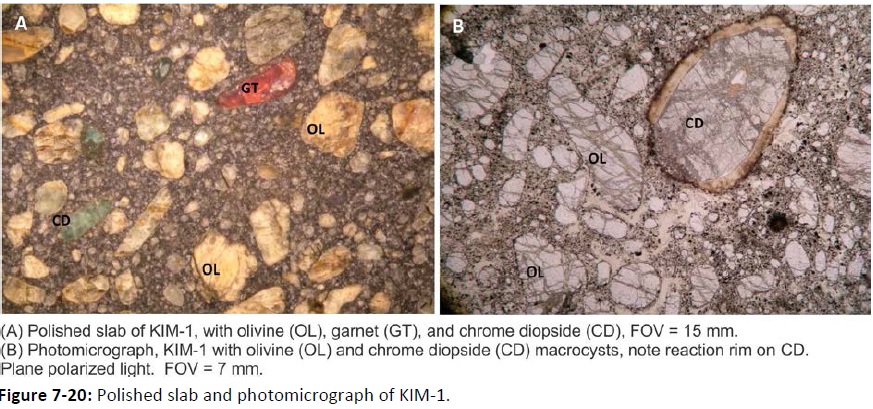
On the left image, the yellow or highlighted 'OL' are olivine cysts.
Peregrine Diamonds should be looking very closely at that current core intersection and will hopefully be able to get more core from drilling in the very new future.
The next step for that new kimberlite will be to send a reasonable sample to the SRC to determine if and how many diamonds it contains. That sample will probably need to be larger then the current core intersection they have.
Thursday, July 27, 2017
Drilling at Chidliak
Drilling at Chidliak
Peregrine Diamonds is bringing a 3rd drilling rig to Chidliak for an August 1st start date. This is to add an additional 2,000 to 4,000 metres of drilling capacity to the summer program. The original target for drilling during the summer was 4,500 to 5,000 metres (with 1 drill) and that was subsequently bumped up to 7,500 metres with 2 full drills onsite. A third one should add more capacity, but they have had some issues early on in the program. Once resolved, the possibility of hitting past 7,500 metres is realistic.
The last time Peregrine Diamonds had 2 core drill rigs on the site was in 2010 and the drill rigs were used on multiple anomalies in addition to the CH-6 mini bulk program (15 tonne).
History should give an indication of what the current program is capable of. Below are the details of what was accomplished by each drill rig in 2010.
Drill rig #1:

Drill rig #2:

When adding up the metres for July/August/September of that timeframe, one of the rigs did just under 3,000 metres and the other rig just did over 3,000 metres.
The advantage that Peregrine Diamonds has this year is that the 3 core drill rigs are all within a very limited vicinity. All at CH-6. These are not getting transported to other anomalies via helicopters.
With a quick look at the numbers, a very productive program could yield up to 10,000 metres. Considering July is almost over, a final target of 7,500 to 8,500 metres is probably a reasonable goal.
Results of the first successful drillhole of the season DD33 (2017-07-26 news) has been eye opening. Peregrine Diamonds just needs to focus on executing more successful holes at site to bring even more knowledge to the project. These exercises are about finding information...not just diamonds.
Peregrine Diamonds is bringing a 3rd drilling rig to Chidliak for an August 1st start date. This is to add an additional 2,000 to 4,000 metres of drilling capacity to the summer program. The original target for drilling during the summer was 4,500 to 5,000 metres (with 1 drill) and that was subsequently bumped up to 7,500 metres with 2 full drills onsite. A third one should add more capacity, but they have had some issues early on in the program. Once resolved, the possibility of hitting past 7,500 metres is realistic.
The last time Peregrine Diamonds had 2 core drill rigs on the site was in 2010 and the drill rigs were used on multiple anomalies in addition to the CH-6 mini bulk program (15 tonne).
History should give an indication of what the current program is capable of. Below are the details of what was accomplished by each drill rig in 2010.
Drill rig #1:

Drill rig #2:

When adding up the metres for July/August/September of that timeframe, one of the rigs did just under 3,000 metres and the other rig just did over 3,000 metres.
The advantage that Peregrine Diamonds has this year is that the 3 core drill rigs are all within a very limited vicinity. All at CH-6. These are not getting transported to other anomalies via helicopters.
With a quick look at the numbers, a very productive program could yield up to 10,000 metres. Considering July is almost over, a final target of 7,500 to 8,500 metres is probably a reasonable goal.
Results of the first successful drillhole of the season DD33 (2017-07-26 news) has been eye opening. Peregrine Diamonds just needs to focus on executing more successful holes at site to bring even more knowledge to the project. These exercises are about finding information...not just diamonds.
Monday, June 19, 2017
2017 Summer Program Announced
Peregrine Diamonds have given final details for the 2017 summer program and announced a commencement of June 27th, 2017.
Details of the program can be found on the Peregrine Diamond website -- 2017-06-19
There has been a significant increase in planned drill metres from an original ~5,000 metres to now an approximate ~7,500. There is a chance that they will add a second core drill rig to site to achieve this upgraded target. The current drilling permit allows for 2 core drill rigs and also an RC helicopter rig if needed.
An updated event timeline is located here -- Upcoming events
Details of the program can be found on the Peregrine Diamond website -- 2017-06-19
There has been a significant increase in planned drill metres from an original ~5,000 metres to now an approximate ~7,500. There is a chance that they will add a second core drill rig to site to achieve this upgraded target. The current drilling permit allows for 2 core drill rigs and also an RC helicopter rig if needed.
An updated event timeline is located here -- Upcoming events
Wednesday, April 19, 2017
Synthetic Diamonds
The irony of synthetic diamonds
Producing mines or developing projects in the diamond industry are always having a close eye on the synthetic diamond market and where it is headed. This does include projects like Chidliak when determining what value the diamonds being extracted from Chidliak could be valued and sold at.
A single rough diamond carat produced at a mine site will have quite a variable range of costs across the many producing mines. A single rough synthetic diamond produced in a lab will have a cost based on the amount of energy and time and materials that are needed to produce that single stone. From that point on, the costs of polishing, marketing, selling are relatively all the same.
A single rough diamond carat will be extracted from a very old volcano emplaced in a kimberlite pipe. A single rough synthetic diamond carat will be produced in a lab. The question that needs to be asked is where that lab get its energy from to create the stone.
The answer to the energy question is basically where is energy is the cheapest. Synthetic diamonds are small and very portable, there is virtually no cost to transporting these stones...so they can basically be produced anywhere in the world. So, to answer the energy question, one only needs to look at digital currency with the likes of bitcoin and other players. Digital currencies are produced via computer algorithms and these computers need cheap electricity to get the most profit out of producing a digital coin. They also generate a lot of heat....so dispersal of heat is also a direct input to the cost. A simple google search will reveal that iceland has bit currency farms for very good reasons.
Iceland - A very geothermal friendly, active volcanoes, and a very young (geologically) country. A mere 18 million years old. This geothermal energy generates consistent and renewable energy that is very environmental sound. Sounds like a perfect home for a synthetic diamond manufacturer.
Synthetic diamonds are still mostly in the research phase. A lot of the companies that are producing synthetic diamonds for the jewellery market are not actually making money...especially when one takes into account the capital cost. These labs are in different parts of the world where the scientists are...not necessarily where it is the cheapest to produce.
One day, there may be a shift to move these into full production in a place like iceland.
The true irony of synthetic diamonds is that they will one day be made by current volcanoes (the energy from) versus real diamonds that are made by ancient volcanoes (kimberlite pipes).
Producing mines or developing projects in the diamond industry are always having a close eye on the synthetic diamond market and where it is headed. This does include projects like Chidliak when determining what value the diamonds being extracted from Chidliak could be valued and sold at.
A single rough diamond carat produced at a mine site will have quite a variable range of costs across the many producing mines. A single rough synthetic diamond produced in a lab will have a cost based on the amount of energy and time and materials that are needed to produce that single stone. From that point on, the costs of polishing, marketing, selling are relatively all the same.
A single rough diamond carat will be extracted from a very old volcano emplaced in a kimberlite pipe. A single rough synthetic diamond carat will be produced in a lab. The question that needs to be asked is where that lab get its energy from to create the stone.
The answer to the energy question is basically where is energy is the cheapest. Synthetic diamonds are small and very portable, there is virtually no cost to transporting these stones...so they can basically be produced anywhere in the world. So, to answer the energy question, one only needs to look at digital currency with the likes of bitcoin and other players. Digital currencies are produced via computer algorithms and these computers need cheap electricity to get the most profit out of producing a digital coin. They also generate a lot of heat....so dispersal of heat is also a direct input to the cost. A simple google search will reveal that iceland has bit currency farms for very good reasons.
Iceland - A very geothermal friendly, active volcanoes, and a very young (geologically) country. A mere 18 million years old. This geothermal energy generates consistent and renewable energy that is very environmental sound. Sounds like a perfect home for a synthetic diamond manufacturer.
Synthetic diamonds are still mostly in the research phase. A lot of the companies that are producing synthetic diamonds for the jewellery market are not actually making money...especially when one takes into account the capital cost. These labs are in different parts of the world where the scientists are...not necessarily where it is the cheapest to produce.
One day, there may be a shift to move these into full production in a place like iceland.
The true irony of synthetic diamonds is that they will one day be made by current volcanoes (the energy from) versus real diamonds that are made by ancient volcanoes (kimberlite pipes).
Monday, April 3, 2017
Video - Drilling and PEA
Video blog discussing drilling and PEA.
Here is a short video (~17 minutes) that discusses the proposed drilling program for the summer of 2017 and takes a quick analysis as to what may be expected with an updated PEA as the end result of the drilling.
Here are the calculations mentioned in the video:

The end result is a discounted NPV that could reach CAD$1.2 billion depending on the results of the drilling. An increase in close to CAD$500 million in value add from the original PEA.
Here is a short video (~17 minutes) that discusses the proposed drilling program for the summer of 2017 and takes a quick analysis as to what may be expected with an updated PEA as the end result of the drilling.
Here are the calculations mentioned in the video:

The end result is a discounted NPV that could reach CAD$1.2 billion depending on the results of the drilling. An increase in close to CAD$500 million in value add from the original PEA.
Thursday, March 30, 2017
Proposed Summer Drilling
Summer Drill Program - 2017
The timeline is set to start the summer program in about 2 to 3 months from now once the spring melt occurs in and around June.
There is more detail on the planned program. The proposed drillholes are listed in the recent AGM presentation -- AGM Update PDF
On Page 17, the planned drillholes are shown on the image.
This program will try and use the benefits of horizontal drilling to gain more information for less $$'s. On the diagram on page 17, one can see the 'parent' drillhole and the associated wedging off that hole to enter kimberlite pipe at various depths.
The final quantity of drilling footage is still a work in progress and there is a possibility of utilizing 2 core drill rigs instead of just the one already onsite. The equipment listed in the permit to work at Chidliak does list and allow for 2 core drill rigs, so it is just a question of procuring and mobilizing a second rig to site.
All work from the summer program will feed into a second or updated PEA that should include a new underground portion of the CH-6 kimberlite pipe on the assumption the resource continues to a depth of around 500 metres. They will know if it does in a few months from now when the drilling occurs.
The timeline is set to start the summer program in about 2 to 3 months from now once the spring melt occurs in and around June.
There is more detail on the planned program. The proposed drillholes are listed in the recent AGM presentation -- AGM Update PDF
On Page 17, the planned drillholes are shown on the image.
This program will try and use the benefits of horizontal drilling to gain more information for less $$'s. On the diagram on page 17, one can see the 'parent' drillhole and the associated wedging off that hole to enter kimberlite pipe at various depths.
The final quantity of drilling footage is still a work in progress and there is a possibility of utilizing 2 core drill rigs instead of just the one already onsite. The equipment listed in the permit to work at Chidliak does list and allow for 2 core drill rigs, so it is just a question of procuring and mobilizing a second rig to site.
All work from the summer program will feed into a second or updated PEA that should include a new underground portion of the CH-6 kimberlite pipe on the assumption the resource continues to a depth of around 500 metres. They will know if it does in a few months from now when the drilling occurs.
Monday, March 13, 2017
2017 summer program
The focus for the development of the Chidliak resource will be carefully selected work to be done during the summer season.
It will be three fold.
1 - Deep core drilling to extend the resource to a target of 500 metres below surface.
2 - Drilling through the adjacent country rock to core log geotechnical data.
3 - Continued environmental/permitting studies (baseline and others) for both the project area and the all weather road corridor.
Starting with #3 - environmental studies are necessary in the permitting process.
Here is a history and some information on permitting -- Permitting details
One of the snippets of information from that link is this:
"The emphasis of a lengthy environmental baseline is very important in the permitting process. Ranging from 6 years to 9 years in a couple of the projects above. Chidliak started independent environmental baseline studies in 2009 and continue each and every year. 2016 will be year 7."
Chidliak did have a baseline study in 2016 and will have another one in 2017. That would put it in the 8 years of studies category that can be included in any advanced permitting applications. The key is the continual studies and it just takes time to collect that information. Meadowbank mine had 9 years of studies going into its final environmental impact assesssment. Chidliak is well on its way in this part of the requirement.
#1 and #2 will be obtained from the same core drilling by utilizing slightly angled holes in the country rock that will pierce the lower part of the kimberlite pipe (300 to 500 metres below surface).
More geotechnical drilling means a more realistic approach as opposed to very conservative approach when deciding what pit wall angles to use. This effects the strip ratio and how much waste one needs to extract or leave in the ground. Geotechnical core drilling will also be used within the kimberlite pipe to help define the size of the stopes that can be extracted underground safely. Bigger stopes means bigger cost savings. Bigger stopes also can lead to more risk to failures.
Deeper kimberlite expansion means expansion of the inferred resource at CH-6 and the concept of bringing in an underground portion to an updated PEA.
In the latest presentation -- 2017-03-01 Presentation
On page 19, there is a big drop off in positive cash flow starting in year 6 and beyond.
The goal will be to prevent that drop off from happening and keep the strong cash flow going for a few more years. The rock value of CH-6 is very lucrative and an underground concept can add substantially to the cash flow in the years 6 to 10. The drilling needs to be done to confirm this and this is a huge part of why the program was selected.
Ch-7 tonnage will be still be included in the PEA. It will be pushed back as far as possible until further work on CH-7 can increase the rock value in light of the diamond breakage issue. If the mine life extends to 15 years, the size of the mill will be put in question and may be increased. This will help bring higher value material further into the present.
It will be three fold.
1 - Deep core drilling to extend the resource to a target of 500 metres below surface.
2 - Drilling through the adjacent country rock to core log geotechnical data.
3 - Continued environmental/permitting studies (baseline and others) for both the project area and the all weather road corridor.
Starting with #3 - environmental studies are necessary in the permitting process.
Here is a history and some information on permitting -- Permitting details
One of the snippets of information from that link is this:
"The emphasis of a lengthy environmental baseline is very important in the permitting process. Ranging from 6 years to 9 years in a couple of the projects above. Chidliak started independent environmental baseline studies in 2009 and continue each and every year. 2016 will be year 7."
Chidliak did have a baseline study in 2016 and will have another one in 2017. That would put it in the 8 years of studies category that can be included in any advanced permitting applications. The key is the continual studies and it just takes time to collect that information. Meadowbank mine had 9 years of studies going into its final environmental impact assesssment. Chidliak is well on its way in this part of the requirement.
#1 and #2 will be obtained from the same core drilling by utilizing slightly angled holes in the country rock that will pierce the lower part of the kimberlite pipe (300 to 500 metres below surface).
More geotechnical drilling means a more realistic approach as opposed to very conservative approach when deciding what pit wall angles to use. This effects the strip ratio and how much waste one needs to extract or leave in the ground. Geotechnical core drilling will also be used within the kimberlite pipe to help define the size of the stopes that can be extracted underground safely. Bigger stopes means bigger cost savings. Bigger stopes also can lead to more risk to failures.
Deeper kimberlite expansion means expansion of the inferred resource at CH-6 and the concept of bringing in an underground portion to an updated PEA.
In the latest presentation -- 2017-03-01 Presentation
On page 19, there is a big drop off in positive cash flow starting in year 6 and beyond.
The goal will be to prevent that drop off from happening and keep the strong cash flow going for a few more years. The rock value of CH-6 is very lucrative and an underground concept can add substantially to the cash flow in the years 6 to 10. The drilling needs to be done to confirm this and this is a huge part of why the program was selected.
Ch-7 tonnage will be still be included in the PEA. It will be pushed back as far as possible until further work on CH-7 can increase the rock value in light of the diamond breakage issue. If the mine life extends to 15 years, the size of the mill will be put in question and may be increased. This will help bring higher value material further into the present.
Tuesday, November 29, 2016
2017 Field Program
2017 field program (winter/spring - early 2017)
A lot of details have been coming out for the upcoming field program.
The two questions that need to be asked are:
1 - What are the details?
2 - What will this accomplish?
The answer to question 2 is the most important..but that cannot be answered without delving into question 1.
So, what are the details?
CH-6 will be the focus for this program.
Tasks?
1 - Bulk trench sample x 500 tonnes (1000 to 2000 carat parcel). Small number of limited blasts and hauling of material into 1 tonne bags to send down to the SRC for processing and recovery of rough diamonds.
2 - LDD - RC - The Large Diameter Drill will drill deep into CH-6. Probably a few holes. Maybe up to 500 tonnes of material that will be screened to above 1.13 mm. Minor adjustments will be made to hopefully reduce the expected breakage to occur. This should create another 1000 to 2000 carats of rough diamonds that will be shipped in 1 tonne bags down to the SRC for processing.
3 - Geotechnical drilling - Core drilling in the country rock to establish conservative, yet reasonable pit slopes for an open pit mine.
4 - Core drilling at depth. The geotechnical holes in #3 will be aimed toward the kimberlite at 300 metres or lower to establish an extension of the known resource.
5 - Core drilling in kimberlite -- Twin the LDD holes for validation, drill deep to extend depth, drilling around the high grade zone (4cpt+) to better define the zone.
6 - Related surface tasks - 2 airstrips on frozen lakes - 1 long strip (10+ km's away) and 1 small strip (5+ km's away) to bring in people, equipment, etc. Establish winter trail to bring in equipment and supplies and to be used to ship out the bulk sample material to Iqaluit.
This an estimated list of tasks (above) and may differ when a final and detailed program is released. Some of the items above have been taken from permit applications and news articles.
So, what will this accomplish?
Increase the economics and continual de-risk of the project.
In the PEA (preliminary economic assessment), the majority of the NPV was front end loaded with CH-6 and CH-7 provided an extension to the life of mine with positive cash flow.
Heading toward the next step is the PFS (Prelminary Feasibility study). With the focus of CH-6, the indicated resources that can be used in the PFS will only come from CH-6.
Not all carats in the PEA were used in the PEA. Why? The biggest reason was the strip ratio used in the study due to lack of geotechnical information.
Here is a link that talks about strip ratio -- Strip Ratio
The end result for CH-6 in the PEA was an average of 10 to 1 (waste to ore) and that is just the average. Reality is the upper tonnage is a lot smaller than 10 to 1 and the tonnage near the bottom of the pit is much higher than 10 to 1. Once further geotechnical information is obtained, the pit wall angle can be steepened up to something more reasonable based on real data instead of just defaulting to the most conservative angle. Will this decrease the strip ratio from 10 to 1 to something lower?
Not necessarily. With steeper pit walls, you can go deeper into the ground, so those tonnages even lower will still have larger strip ratios. The aim of the project is also to deepen the existing resource even further as well.
On a resource side, the main goal will be to convert inferred and add even more tonnage to the indicated category to be used in a PFS study.
End result? With the significant rock value of CH-6, adding more tonnage has a very significant effect to the project and NPV. The valuation timeframe for the PEA (february 2016) was done at a dip in the rough diamond price market. The valuation is up over 10% since then and there is a reasonable chance to say that the PFS will be done at a time where rough diamond prices are higher then the PEA timeframe.
What is the end result?
Coming up with a PFS that has a pre-tax NPV (@7.5%) of CAD$1 billion is probably a very reasonable goal. It would be a great accomplishment and outcome from this upcoming winter/spring program.
Other possible tasks?
1 - There is a sub-domain that doesn't have a valuation assigned to it and is considered waste with 0 value now. Possibility of putting an LDD RC drillhole into this to obtain more data.
2- There is a string of pearl (kimberlite pipe) north of CH-6 that the open pit will break into. If they can deepen CH-6, it will grab even more tonnage from this pipe. Possibility of putting an LDD RC drillhole into this to obtain more data.
A lot of details have been coming out for the upcoming field program.
The two questions that need to be asked are:
1 - What are the details?
2 - What will this accomplish?
The answer to question 2 is the most important..but that cannot be answered without delving into question 1.
So, what are the details?
CH-6 will be the focus for this program.
Tasks?
1 - Bulk trench sample x 500 tonnes (1000 to 2000 carat parcel). Small number of limited blasts and hauling of material into 1 tonne bags to send down to the SRC for processing and recovery of rough diamonds.
2 - LDD - RC - The Large Diameter Drill will drill deep into CH-6. Probably a few holes. Maybe up to 500 tonnes of material that will be screened to above 1.13 mm. Minor adjustments will be made to hopefully reduce the expected breakage to occur. This should create another 1000 to 2000 carats of rough diamonds that will be shipped in 1 tonne bags down to the SRC for processing.
3 - Geotechnical drilling - Core drilling in the country rock to establish conservative, yet reasonable pit slopes for an open pit mine.
4 - Core drilling at depth. The geotechnical holes in #3 will be aimed toward the kimberlite at 300 metres or lower to establish an extension of the known resource.
5 - Core drilling in kimberlite -- Twin the LDD holes for validation, drill deep to extend depth, drilling around the high grade zone (4cpt+) to better define the zone.
6 - Related surface tasks - 2 airstrips on frozen lakes - 1 long strip (10+ km's away) and 1 small strip (5+ km's away) to bring in people, equipment, etc. Establish winter trail to bring in equipment and supplies and to be used to ship out the bulk sample material to Iqaluit.
This an estimated list of tasks (above) and may differ when a final and detailed program is released. Some of the items above have been taken from permit applications and news articles.
So, what will this accomplish?
Increase the economics and continual de-risk of the project.
In the PEA (preliminary economic assessment), the majority of the NPV was front end loaded with CH-6 and CH-7 provided an extension to the life of mine with positive cash flow.
Heading toward the next step is the PFS (Prelminary Feasibility study). With the focus of CH-6, the indicated resources that can be used in the PFS will only come from CH-6.
Not all carats in the PEA were used in the PEA. Why? The biggest reason was the strip ratio used in the study due to lack of geotechnical information.
Here is a link that talks about strip ratio -- Strip Ratio
The end result for CH-6 in the PEA was an average of 10 to 1 (waste to ore) and that is just the average. Reality is the upper tonnage is a lot smaller than 10 to 1 and the tonnage near the bottom of the pit is much higher than 10 to 1. Once further geotechnical information is obtained, the pit wall angle can be steepened up to something more reasonable based on real data instead of just defaulting to the most conservative angle. Will this decrease the strip ratio from 10 to 1 to something lower?
Not necessarily. With steeper pit walls, you can go deeper into the ground, so those tonnages even lower will still have larger strip ratios. The aim of the project is also to deepen the existing resource even further as well.
On a resource side, the main goal will be to convert inferred and add even more tonnage to the indicated category to be used in a PFS study.
End result? With the significant rock value of CH-6, adding more tonnage has a very significant effect to the project and NPV. The valuation timeframe for the PEA (february 2016) was done at a dip in the rough diamond price market. The valuation is up over 10% since then and there is a reasonable chance to say that the PFS will be done at a time where rough diamond prices are higher then the PEA timeframe.
What is the end result?
Coming up with a PFS that has a pre-tax NPV (@7.5%) of CAD$1 billion is probably a very reasonable goal. It would be a great accomplishment and outcome from this upcoming winter/spring program.
Other possible tasks?
1 - There is a sub-domain that doesn't have a valuation assigned to it and is considered waste with 0 value now. Possibility of putting an LDD RC drillhole into this to obtain more data.
2- There is a string of pearl (kimberlite pipe) north of CH-6 that the open pit will break into. If they can deepen CH-6, it will grab even more tonnage from this pipe. Possibility of putting an LDD RC drillhole into this to obtain more data.
Subscribe to:
Posts (Atom)